
Effective and Ineffective Practices in Scientific Journal Management: A Webinar by Pulse of Science
On May 13 at 11:00 AM, Pulse of Science invites you to a webinar dedicated to modern approaches to scientific journal management. Experts will analyze tools for journal development, quality enhancement, and boosting scientometric indicators, while also identifying common pitfalls that hinder progress.
In today’s environment, the success of a scientific journal depends not only on content quality but also on the efficiency of editorial processes. The CoLab.ws platform—which hosts prestigious titles such as the highly-cited Russian Chemical Reviews (Q1) and the successful new project Journal of Mesoscience and Nanotechnology—has analyzed extensive data from its partnership with editorial boards.
Key Topics:
- Systematizing factors that drive growth in scientometric indicators.
- Outdated and ineffective practices that negatively impact citations.
- Optimizing editorial board workflows and modern management tools.
- Case studies and real-world insights from CoLab.ws.
Guest Expert:
Nikita Buryak, Director of Development at CoLab.ws.
We invite editors, publishers, and editorial board members to join the discussion.
- Date and Time: May 13, 11:00 AM
- Participation: Free of charge
- Certificate: An e-certificate will be issued to participants who attend the full session.
Register for the Webinar: https://pruffme.com/landing/pulsescience/pulsescience13052026
Don’t miss this opportunity to learn how to optimize your publication and increase its visibility within the international scientific community!
"Antiplagiat " for Publishers: Discover What's New at an Open Webinar on March 26
The ELPUB educational program invites editors, publishers, and all interested professionals to join the open webinar: "Antiplagiat for Editors and Publishers: What’s New?"
The Antiplagiat system is constantly evolving. At this upcoming session, experts will share the latest updates and trends directly impacting the management of scientific content.
- When: March 26 at 11:00 AM (Moscow Time)
- Speaker: Olga Filippova, Lead Specialist at the Antiplagiat Training and Methodology Center.
- Registration: Open via this link: https://pruffme.com/landing/elpub/AP2026_1
- Conditions: Participation is free. Certificates will be provided upon completion.
Agenda:
- Anti-Plagiarism in Elpub for editors and publishers;
- And... AI again. Current insights into the Artificial Intelligence detector;
- A "Pas de Deux" with DD: Why a duplicate detector flag isn't a verdict, but a "dance for two";
- To include or not to include: Revisiting bibliography checks;
- Antiplagiat 2.0 and the Crystal Ball: The gift of commenting;
- New modules and expansion of existing collections;
- Future development plans for the Antiplagiat system beneficial to the publishing industry.
Join to learn how to maximize the potential of Antiplagiat!
GenAI in Scholarly Publishing: Expectations vs Reality 2026
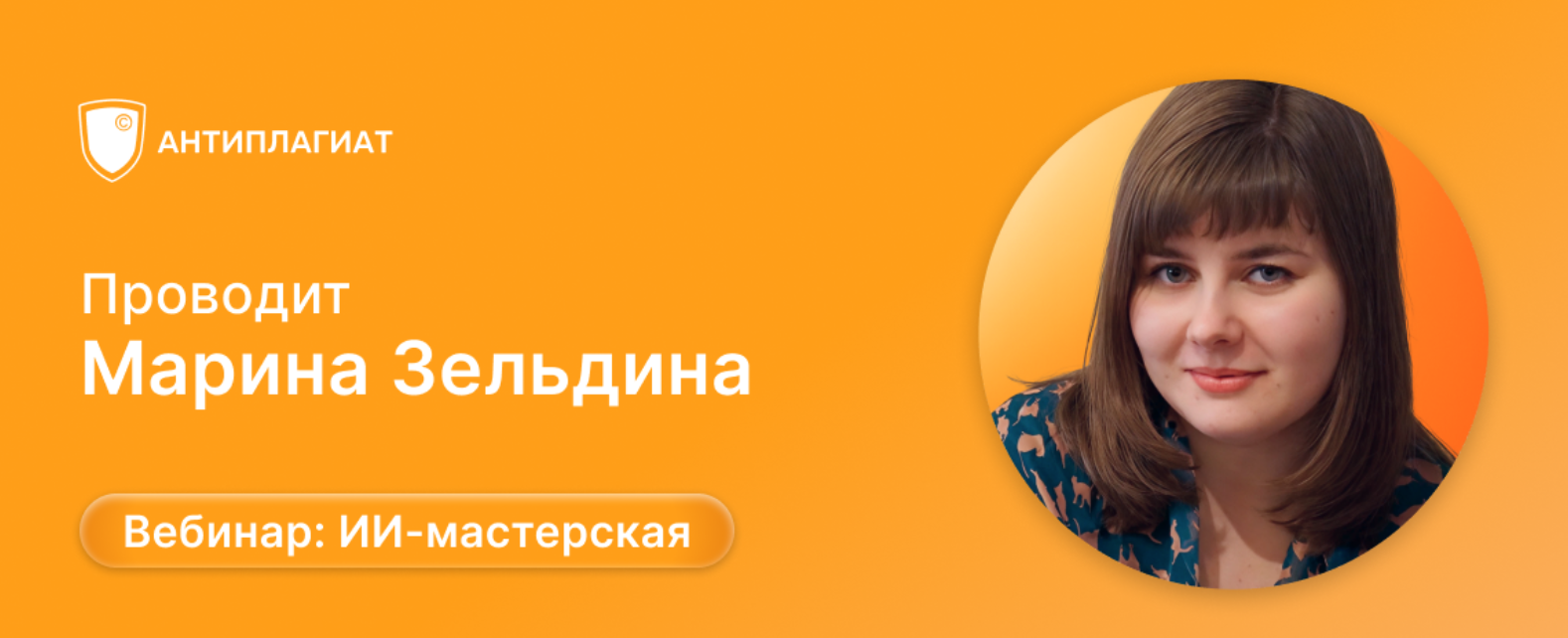
Antiplagiat and Elpub invite editors, authors, and researchers to join the webinar "GenAI in Publishing: Expectations and Reality (2026 Version)." This event is part of the "AI Workshop" educational project by Antiplagiat.
When: March 19, 2026, at 11:00 AM (MSK)
Join here: https://my.mts-link.ru/j/1176571/13928677352
Generative AI (GenAI) has become a staple in the scientific community, but have the forecasts of previous years actually come true? This webinar will provide an industry analysis and address key questions:
- Are the initial promises being met?
- Has the editor's job actually become easier?
- Has the quality of scientific papers improved?
- What GenAI-related questions are scientists currently investigating?
- Are existing standards and guidelines for GenAI in journals actually working?
Speaker: Marina Zeldina, Head of the Elpub.Education project (NEICON).
Certificates: All participants who attend the full session will receive personalized certificates. Please ensure your full name is entered correctly during registration.
Please note: Space is limited.
The video recording of the webinar "New on Elpub: AI Detection and Plagiarism Checks by Domate" is now available in the Elpub Knowledge Base!
On March 5, 2026, a webinar was held to discuss the new built-in text verification system, Domate, which has been available to Elpub users since February. The session featured Yury Chekhovich, the system's creator, founder of Domate, and head of a laboratory at the V.A. Trapeznikov Institute of Control Sciences of the RAS.
Participants witnessed a live demonstration of the tool's capabilities, learned about its future development plans, and asked questions on how to distinguish human-written text from AI-generated content.
The webinar recording is now publicly accessible in the ELPUB Knowledge Base for everyone interested.
Elpub Webinar: “When a Reference Looks Real: Bibliographic Confabulations Generated by AI in Scholarly Publishing”
On March 12, 2026 at 12:00 (Moscow time), an open webinar titled “When a Reference Looks Real: Bibliographic Confabulations Generated by AI in the Practice of a Scholarly Journal” will be held as part of the Elpub Educational Program. Participation is free, but registration is required.
Registration: https://pruffme.com/landing/elpub/fakereference
The speaker: Svetlana Aleksandrovna Morozova, Deputy Director of the Fundamental Library and Senior Lecturer at the Department of Theory and Methods of Continuing Pedagogical Education, Institute of Pedagogy, Herzen State Pedagogical University of Russia.
The session will address one of the most pressing challenges in contemporary scholarly communication — the emergence of inaccurate yet seemingly credible bibliographic references generated by AI tools. Based on an analysis of Russian‑language articles published in peer‑reviewed journals, the webinar will demonstrate that fake references appear not only in papers by early‑career researchers but also in works authored by experienced scholars, including journals indexed in the Russian Science Citation Index (RSCI), listed by the Higher Attestation Commission (VAK), and included in the White List.
Key topics:
- practical approaches to classifying and detecting AI‑generated inaccurate references;
- fake bibliographies as indicators of AI‑induced hallucinations within research texts;
- the formation of “propagation chains” of false references through subsequent publications.
Participants will receive a certificate.

Page 1 of 11